Nature-Based Solutions Case Studies
As easy it would be for me to say I had a sudden realization that nature-based solutions are going to be my new path, I can’t! The reason being, I had it set in mind for a while. Nature-based solutions are the foundation for resilience and solutions and climate change effects. They are what could help cities and countries, really, stand the forces of climate change, while simultaneously aligning all natural earth processes to mitigate and recover from the effects of climate change. How is this possible!? Well, what do you think nature-based solutions mean? Pay attention to each word and connect it! What do you think? I bet you can figure it out!
By definition, nature-based solutions are actions that tackle societal challenges, climate change, disasters, food and water security, biodiversity loss, and human health with the main workforce being nature and simultaneously benefiting human well-being and biodiversity locally. Let’s review two case studies that utilize nature-based solutions. One is a successfully completed project and the other is a well-intentioned project that received funds but may not actually be in progress anymore. That is to be determined after we take a look at the projects. The reason we are looking at these two studies is because I want you to be well acquainted with the concept of nature-based solutions. If you are interested, we also have a free course that allows you to create your own nature-based solution to a scenario project. Visit it here:
Let’s begin! 👇🏾Scroll BELOW

Nature has a great simplicity and therefore a great beauty.
-Richard P. Feynman
Mirabeau Water Garden New Orleans, Louisiana (Gentilly)
Mirabeau Water Garden is a deliberately “let the water in” project: a 25-acre former convent site in Gentilly, positioned between Bayou St. John and the London Avenue Canal, redesigned to temporarily store stormwater and reduce neighborhood flooding. NOLA.gov. The problem it targets is intense rainfall + low-lying urban topography + limited drainage capacity = street and structure flooding (and all the public health, mold, and economic chaos that follows). The solution is to convert open land into a managed, floodable landscape with detention lagoons, controlled outfalls (weirs), and supporting pump and drainage features so peak runoff gets pulled out of the pipe system and released more slowly NOLA.gov. You can read the entire Mirabeau Water Garden Fact Sheet HERE.
In nature-based solution terms, it fits because it uses a “natural or modified ecosystem” (constructed wetland/lagoon landscape) to address a societal challenge (flood risk) while aiming for co-benefits like cooling, habitat, and community greenspace. That’s basically the definition of NbS, whether we like acronyms or not IUCN Portals. The design intent is multi-use: stormwater detention areas that double as recreation/education space, plus permeable surfaces, paths, and programming around climate and stormwater literacy NOLA.gov.
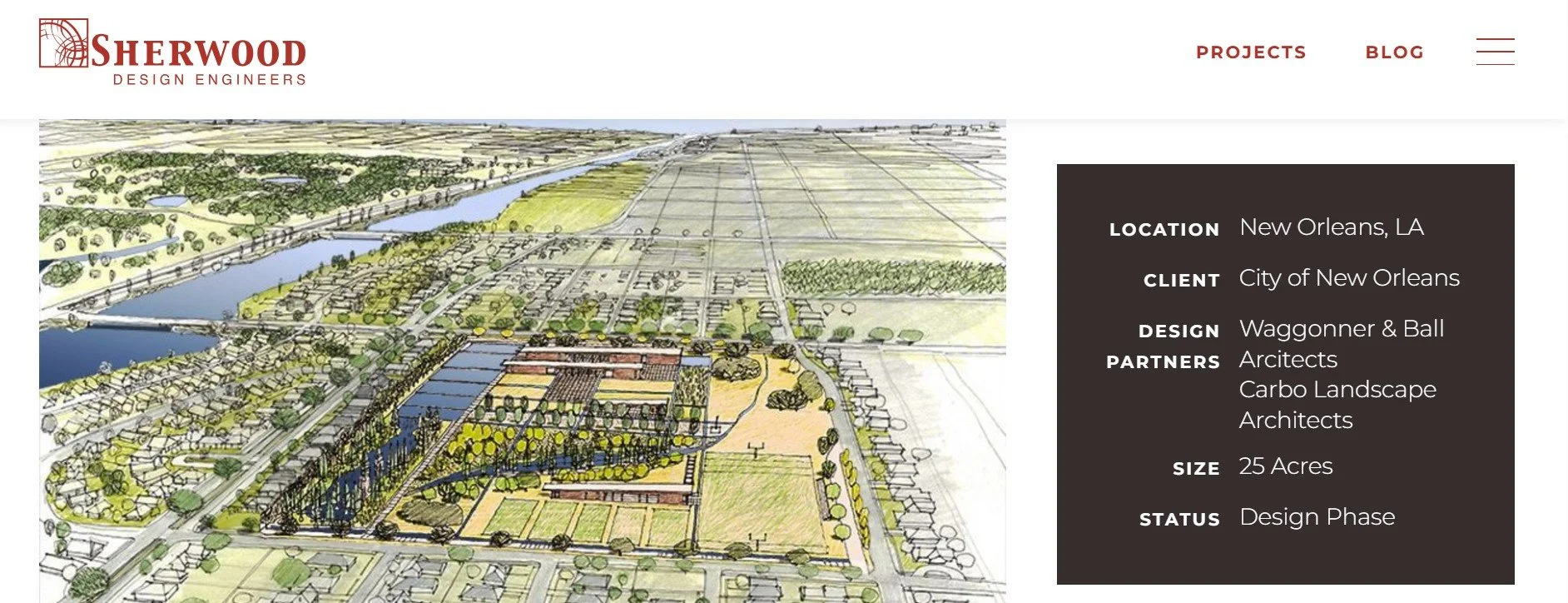
Mirabeau Water Garden Sketch by Sherwood Design Engineers
Timeline matters because this project has lived several lives. The concept is tied to the “Dutch Dialogues” resilience planning work (2008) and was further shaped through the Greater New Orleans Urban Water Plan (2013), then pushed forward with major resilience funding tied to HUD’s National Disaster Resilience efforts announced in 2016. Waggonner & Ball The city finally held the official groundbreaking on December 11, 2023. NOLA.gov Public reporting at groundbreaking time commonly framed completion as “sometime in 2025,” which should have been a red flag because… well… construction and bureaucracy exist https://www.fox8live.com.
Is it complete? As of late 2025 reporting, it is described as under construction, with Phase 1 completion “in sight,” not finished or as understood from the Sherwood Engineers, they are in design phase (unless they never updated the status since, well, 2025. I say this because according to a 2023 WGNO NEWS story, the Mirabeau Water Garden broke ground. It’s nice to do a story so uplifting and hopeful for our planet, just for you to hear two years later it wont be finished for another couple years, longer, or EVER with the way things are looking! This $31 million dollar project is in limbo at this moment.
A federal audit of the Gentilly Resilience District funding (which includes Mirabeau) criticized the city for insufficient planning, poor agreements with landowners/utility providers, lack of staffing and execution plans, and delays on start of construction for several projects funded through federal hazard mitigation and resilience grants. The report suggested that many of the resilience grants—not just the Mirabeau component—had not translated into tangible construction or measurable outcomes years after awards were made.
So the situation isn’t simply “the city got a grant and is hoarding it.” Instead, federal grant compliance requirements, complex intergovernmental coordination, phasing of construction contracts, and unresolved planning or property agreement issues have slowed actual deployment of funds and progress on some components of the resilience district. These kinds of delays are unfortunately not unusual when multiple federal funding streams (state matching requirements, city procurement and contract processes) all converge on a single project. It’s possible that specific line items in the grant are still obligated but not fully expended because construction phases haven’t yet run their full course or because documentation and reimbursement processes are ongoing—but there’s no credible reporting stating the city literally refuses to spend the funds without cause.
Here are some paths and solutions to resuming this project!
Dedicated project office
There is too much going on! If the city actually cares about completing this project, how about create a single Mirabeau-only project management unit with authority across departments. Not advisory. Not interagency “coordination.” One office, one director, one chain of command that handles compliance, procurement, utilities, and construction sequencing. Fragmentation is the primary delay driver.
Pre-clear compliance pathways
Grant money moves slowly because cities wait to solve compliance after the grant lands. Flip that. Pre-clear NEPA re-evaluations, environmental permits, Section 106 coordination, and reimbursement documentation templates before major construction phases start. Any delays are often paperwork delays, not funding delays.
Utility coordination lock-in
Formalize binding agreements with utility providers early, not “ongoing coordination.” Delays repeatedly come from unresolved sewer, drainage, or power conflicts discovered mid-construction. Lock relocation schedules and responsibilities contractually before ground disturbance, not after equipment shows up.
Phased construction contracts
Stop bundling too much into single contracts. Use phased, milestone-based construction packages that allow the grant provider’s reimbursement as each component is completed. This reduces risk exposure, speeds cash flow, and prevents one delayed element from freezing the entire site.
Staffing surge capacity
Federal grants fail at the local level because cities understaff them. Hire temporary grant administrators, compliance officers, and construction managers paid directly from allowable administrative portions of the grant.
Procurement reform carve-out
Use emergency or resilience-specific procurement pathways where legally allowed. Traditional municipal procurement timelines are incompatible with federally funded mitigation schedules. Cities that move faster use special procurement lanes designed for disaster recovery and resilience projects.
Labor risk mitigation
After the ICE enforcement action, labor continuity became a real risk. Cities can mitigate this by requiring contractors to demonstrate workforce continuity plans, diversified labor sourcing, and contingency staffing before contract award. Pretending labor availability is static is how projects stall.
Transparent public dashboard
Publish a live dashboard showing grant obligations, expenditures, construction milestones, and delays. Transparency forces internal accountability. When residents and funders can see money obligated but not spent, excuses evaporate quickly.
Federal liaison assignment
Assign a dedicated grant liaison embedded in city operations, not contacted ad hoc. Continuous engagement prevents reimbursement freezes and compliance surprises.
Political insulation clause
Shield project leadership from election cycles by contractually protecting continuity of management through completion. Infrastructure timelines do not care about mayoral terms, and neither does floodwater.
Now to the part you asked about: the meanspirited twist where immigration enforcement collides with climate infrastructure.
On May 27, 2025, federal immigration agents conducted an enforcement action at the Mirabeau construction site; trade reporting and local reporting describe workers being detained/arrested (one widely reported figure is 15) La IlluminatorEngineering News-Record. That’s the real-world basis for the “ICE deported construction workers” story. What’s not reliably documented in the same sources is a confirmed deportation count or a verified, direct causal statement like “this is why completion slipped X months.” The city publicly said it intended to keep the project on track. Verite News
Why no completion photos? Because there is no completion to photograph yet. The City’s own project page has leaned on visualizations/renderings (which is what agencies do when the site is still a construction zone), and recent credible descriptions still call it under construction. NOLA.gov Also, active sites are often access-restricted for safety/liability, and the 2025 enforcement incident likely didn’t increase anyone’s enthusiasm for casual on-site photography.
Cascades Park, Tallahassee, Florida
Cascades Park is what happens when a city decides a flood-control facility doesn’t have to look like a sad concrete ditch people avoid. It’s explicitly designed as a stormwater management system that also functions as a major downtown park Talgov. The problem it solves is chronic flooding and stormwater impacts in a low-lying corridor through downtown Tallahassee, tied to a large contributing drainage area and a history of degraded urban waterways. The solution is a “floodable park” concept: water is routed through a network of underground conveyances, open channels/streams, and retention ponds that are intended to take on water during major storm events, lowering flood pressure on surrounding areas. Talgov+1
So, is Cascades Park a nature-based solution? Functionally, yes, but with a very human caveat: it’s a hybrid. Pure NbS would lean heavily on restored or constructed ecosystems with minimal gray infrastructure. Cascades uses constructed/managed water bodies and wetland-like treatment features plus substantial engineered conveyance and control. One description of the system notes stormwater is conveyed into an upper pond and lower pond with a recreated wetland connecting them, while a major portion of flow is still carried underground via culverts. GSIP Photos Florida That’s textbook “nature-based plus gray infrastructure,” which is still fully compatible with how NbS is commonly implemented in real cities (because cities are allergic to leaving anything entirely to nature).
From an NbS definition standpoint, Cascades checks the boxes: it addresses a societal challenge (flooding/water quality) through management of a modified ecosystem (ponds/wetland features integrated into a park), and it delivers co-benefits (urban cooling, habitat pockets, recreation, and public space). IUCN Portal Blueprint (the regional agency behind major local infrastructure) is unusually blunt about the intent: Cascades Park is “first and foremost a stormwater management system” and is “designed to flood” to provide flood relief Talgov. That’s the core service: hydrologic buffering. The park’s ponds, channels, and floodable landscapes slow, store, and route stormwater so peak flows don’t translate as directly into street flooding.
Cascades also sits in a landscape with environmental history. Parts of the area are associated with contaminated-site cleanup and redevelopment; EPA site materials discuss investigation and no-further-action decisions for groundwater at the Cascade Park site profile, which matters because “park + water” on formerly industrial land requires serious cleanup accountability Cumulis. And unlike Mirabeau, Cascades is not stuck in the “renderings and hope” phase: it is an operational park, widely described as completed (commonly cited around 2014) and actively functioning as stormwater infrastructure today Wikipedia.
Bottom line: Cascades Park is a real, built example of urban resilience where stormwater storage/treatment is embedded into public greenspace. Mirabeau is the same genre, but still wrestling with the usual mix of funding bureaucracy, construction timelines, and the uniquely American habit of sabotaging our own workforce while pretending we want infrastructure. I’ve seen it myself and it is a beautiful place to picnic, practice whatever skill, and to run! So many benefits!
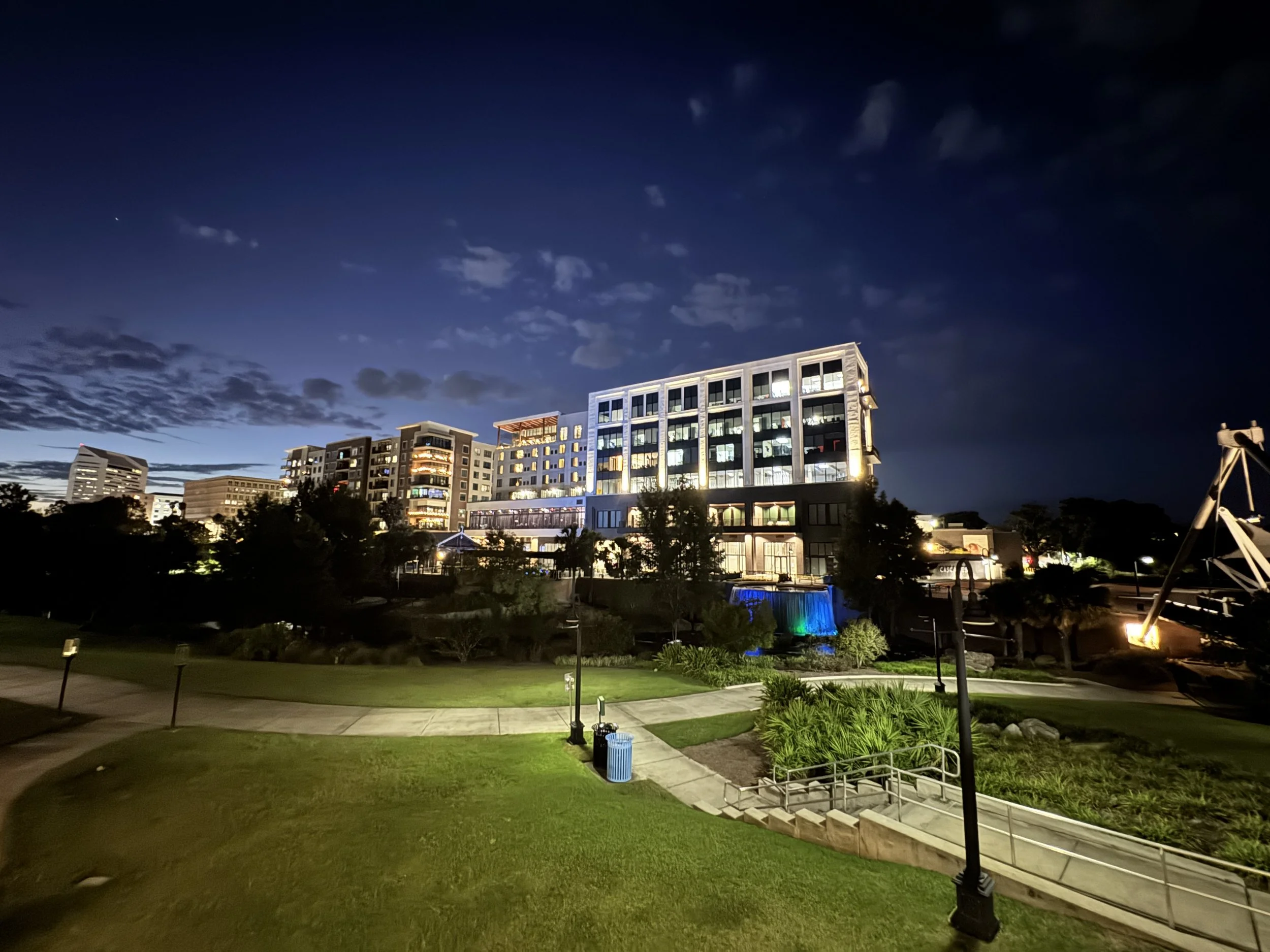
Night Sky in September
The view from Cascades Park on a night like this brings aesthetic beauty. Taken by Chrissa on 09/2025.
In CONCLUSION
Mirabeau Water Garden and Cascades Park illustrate both the promise and the friction of nature-based solutions in U.S. cities. In theory, these projects are exactly what climate adaptation is supposed to look like: landscapes designed to absorb, store, and slow water using ecological processes rather than relying solely on concrete and pipes. Cascades Park shows what happens when that theory is executed to completion. It functions as flood infrastructure first and public space second, quietly reducing flood risk while delivering ecological and social co-benefits. Mirabeau, by contrast, shows how a well-designed nature-based solution can stall when administrative capacity, interagency coordination, labor stability, and federal grant management break down. The issue is not the validity of nature-based solutions themselves. The hydrology works. The risk reduction logic is sound. The problem is governance. Nature-based solutions require the same level of project discipline as traditional gray infrastructure, plus additional coordination across environmental compliance, land use, and community access. When those systems fail, the result is delayed resilience while flood risk continues. The takeaway is straightforward: nature-based solutions are not “soft” projects. They are critical infrastructure. Cities that treat them as such, fund them appropriately, staff them adequately, and manage them aggressively get functional flood protection. Cities that do not end up with renderings, unspent mitigation funds, and neighborhoods still waiting for relief.
References (APA)
Blueprint Intergovernmental Agency. (n.d.). Cascades Park. Blueprintia
City of New Orleans. (2023, December 11). Mirabeau Water Garden Groundbreaking. NOLA.gov
City of New Orleans. (2025, August 11). Mirabeau – Stormwater & Green Infrastructure. NOLA.gov
City of Tallahassee. (n.d.). Cascades Park – Features (Designed to Flood). Talgov
Engineering News-Record. (2025, June 24). ICE raids create chilling effect on already-stretched industry workforce (Mirabeau site referenced). Engineering News-Record
Fox 8 WVUE. (2025, May 29). New Orleans drainage project raided by federal immigration agents. https://www.fox8live.com
IUCN. (n.d.). Nature-based Solutions. IUCN
IUCN. (2020). IUCN Global Standard for Nature-based Solutions. IUCN Portals
LA Illuminator. (2025, May 29). Federal immigration agents raid construction site (Mirabeau Water Garden). La Illuminator
Sherwood Design Engineers. (2025, June 2). Mirabeau Water Garden. Sherwood Engineers
Verité News. (2025, June 16). New Orleans ICE construction raids (Mirabeau Water Garden statement and context). Verite News
WWNO. (2023, December 12). After 7 years, New Orleans finally starts construction on Gentilly Resilience District (Mirabeau Water Garden). WWNO
Green Stormwater Infrastructure Photos Florida. (n.d.). Cascades Park interview (upper pond/lower pond/wetland connection).